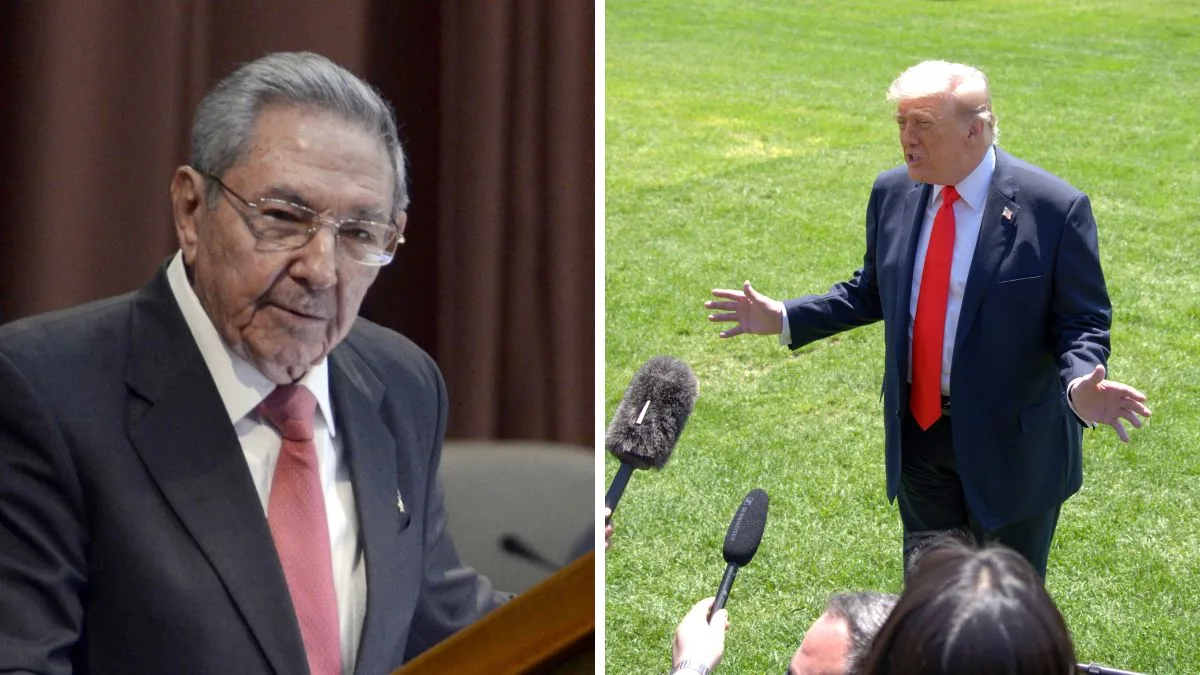
US President Donald Trump on Wednesday said America was “freeing up Cuba” and promised support for the Cuban people after former Cuban President Raul Castro was indicted in the United States over the 1996 downing of two civilian aircraft linked to the Miami-based exile group Brothers to the Rescue.
The indictment has sharply escalated tensions between Washington and Havana, reviving one of the most sensitive fault lines in US-Cuba relations. While Trump signalled that a broader policy announcement on Cuba could be coming soon, the Cuban government dismissed the charges against Castro as politically motivated and accused the US of attempting to justify aggression against the island nation.
Advertisement
Speaking to reporters during an extended media interaction, Trump described Cuba as “a failing nation” and claimed Cuban Americans had waited “65 years” for such action.
“We’re going to help the Cuban people out. We’re freeing up Cuba,” Trump said, according to a statement later shared by the US Department of State on X.
The US President also suggested that Washington could soon unveil a new approach towards Cuba, though he insisted there would be no military escalation.
“There won’t be escalation. I don’t think there needs to be. The place is falling apart. It’s a mess,” Trump said.
What are the charges against Raul Castro?
According to Fox News and statements released by US officials, a Florida grand jury returned the indictment in April, though it was unsealed publicly on Wednesday.
The charges relate to the February 1996 shooting down of two aircraft operated by Brothers to the Rescue, a Miami-based Cuban exile organisation. Four men were killed in the incident: Carlos Costa, Armando Alejandre Jr., Mario de la Pena and Pablo Morales.
US prosecutors have charged Castro with conspiracy to kill US nationals, destruction of aircraft and four counts of murder.
Acting US Attorney General Todd Blanche, speaking during a ceremony in Miami honouring the victims, said the men were flying “humanitarian missions for the rescue and protection of people fleeing oppression across the Florida Straits”.
“As alleged in the indictment, Raul Castro and five co-defendants participated in a conspiracy that ended with Cuban military aircraft firing missiles at those planes and killing four Americans,” Blanche said.
FBI Director Kash Patel also reacted strongly to the indictment, saying the agency had “never forgotten” the victims.
“For 30 years, their families waited for answers. This FBI never forgot,” Patel said.
The development comes amid heightened military signalling in the region. The US Southern Command announced that the Nimitz Carrier Strike Group had arrived in the Caribbean, including an aircraft carrier, its air wing and at least one guided-missile destroyer.
Cuba accuses US of fabricating case
Cuban President Miguel Diaz-Canel hit back at Washington, calling the indictment a “political manoeuver” without any legal basis.
In a post on X, Diaz-Canel accused the US of trying to build a false narrative to justify hostility towards Cuba.
“This is a political maneuver, devoid of any legal foundation, aimed solely at padding the fabricated dossier they use to justify the folly of a military aggression against Cuba,” he said.
The Cuban leader defended Havana’s actions during the 1996 incident, arguing that Cuba had acted in “legitimate self-defence” after repeated violations of its airspace by the exile group.
He claimed Cuba had issued several warnings before the aircraft were shot down and insisted documentary evidence showed the country had not violated international law.
Diaz-Canel also praised Castro, now 94, calling him a revolutionary leader respected across the world.
“These values are his best defence and a moral shield against the ridiculous attempt to diminish his stature as a hero,” he said.
Trump links Cuba stance to Florida politics
Trump repeatedly referenced support from Cuban Americans during his remarks, particularly in Florida, where Cuba policy remains politically influential.
“They have no food, they have no electricity, they have no energy at all. But they do have great people,” Trump said while describing conditions in Cuba.
Asked whether the decades-old US embargo on Cuba would continue, he responded: “We’ll see. We’ll be announcing it pretty soon.”
The President also used the interaction to discuss Iran negotiations, sanctions and domestic political issues, while defending recent US military operations linked to Tehran.
The US embargo on Cuba has remained in place for more than six decades and continues to be one of the most divisive issues in American foreign policy.